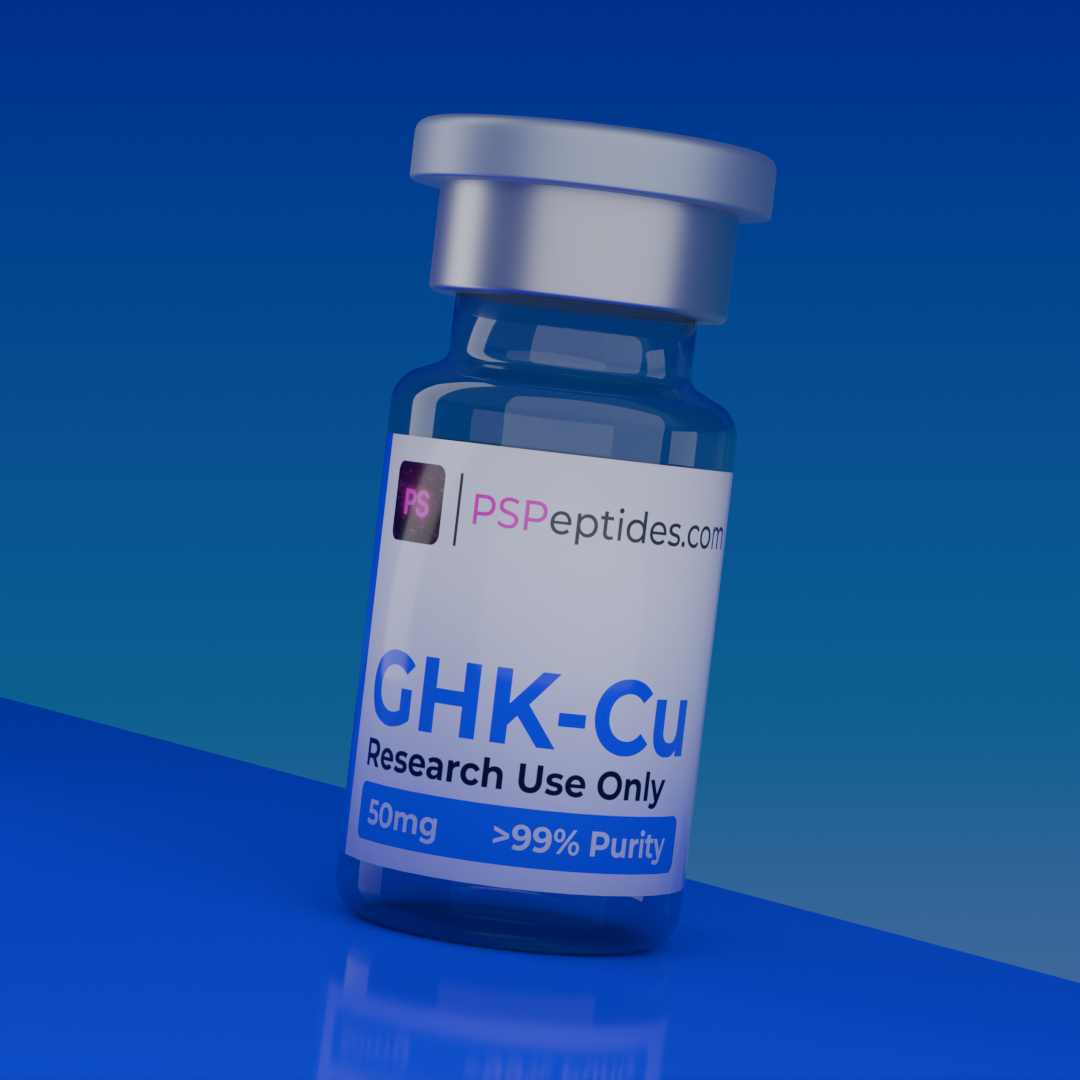
GHK-Cu is the most extensively studied copper peptide in skin regeneration, collagen synthesis, wound healing, and hair follicle research. Select your vial size above and order today — orders placed before 2 PM EST ship the same business day.
GHK-Cu is a naturally occurring tripeptide-copper(II) complex first isolated from human plasma in 1973. It has the molecular formula C14H23N5O4·Cu, a molecular weight of 403.93 Da, and CAS number 49557-75-7. Plasma concentrations average about 200 ng/mL at age 20 and fall to roughly 80 ng/mL by age 60, a decline that tracks the age-related loss of tissue regenerative capacity.
Before you buy GHK-Cu peptide for a study, it helps to know what makes it unique: the tripeptide binds copper with very high affinity and delivers it to enzymes such as lysyl oxidase and superoxide dismutase, while also acting as a signaling molecule that modulates gene expression. For a deeper molecular overview, read our complete GHK-Cu research guide.
Laboratories buy GHK-Cu peptide from PSPeptides for the following research models:
When you buy GHK-Cu peptide from PSPeptides, every vial meets the specifications below:
Detailed Mechanism of Action
Researchers who buy GHK-Cu peptide are working with a compound that acts through at least six parallel biological pathways. The tripeptide itself is a signaling molecule that influences the expression of hundreds of genes involved in tissue repair, while the chelated copper(II) ion supplies a cofactor that several regenerative enzymes require.
Copper delivered by GHK-Cu serves as a cofactor for lysyl oxidase, the enzyme responsible for cross-linking and stabilizing newly formed collagen and elastin fibers. Without adequate bioavailable copper, new collagen remains structurally weak and is rapidly degraded by metalloproteinases. GHK binds Cu(II) with an affinity of roughly 10-14 M, making it one of the most effective natural copper carriers identified in human tissue.
At 403.93 Da, GHK-Cu sits well below the 500 Da threshold generally associated with meaningful skin penetration. This small size explains why topical application models consistently show biological activity in the dermis, and it is one reason this GHK-Cu research peptide is so widely used in skin biology laboratories.
The most striking feature of GHK-Cu is its gene expression profile. Analysis using the Broad Institute’s Connectivity Map found that GHK influences roughly 4,000 human genes, upregulating tissue repair, collagen synthesis, antioxidant, and anti-inflammatory pathways while downregulating genes tied to tissue destruction, inflammation, and fibrosis. Labs that buy GHK-Cu peptide for transcriptomic work typically focus on these repair and antioxidant gene clusters.
Collagen, Extracellular Matrix and Wound Healing Research
Collagen stimulation remains the most common reason to buy GHK-Cu peptide. Foundational work by Maquart and colleagues (1988) in FEBS Letters showed that the tripeptide-copper complex significantly increased collagen synthesis in fibroblast cultures, with later studies reporting increases of up to 70%. GHK-Cu also promotes dermatan sulfate, chondroitin sulfate, decorin, elastin, and glycosaminoglycan production, all critical structural components of the extracellular matrix.
In wound healing models, GHK-Cu attracts immune and endothelial cells to injury sites, stimulates angiogenesis, promotes fibroblast migration, and balances metalloproteinases against their inhibitors. Published studies describe accelerated healing in skin, hair follicles, gastrointestinal tissue, bone, and nerve tissue across multiple animal models. Pickart’s group also documented that GHK restored proliferative capacity to fibroblasts damaged by 5,000 rad of radiation at concentrations as low as 1 nanomolar.

Published Research
GHK-Cu is supported by more than five decades of peer-reviewed literature, which is a major reason researchers buy GHK-Cu peptide rather than less characterized copper complexes.
A landmark 1998 human study (Abdulghani et al.) compared topical GHK-Cu with vitamin C and retinoic acid and reported measurable collagen increases in 70% of volunteers, outperforming both comparators. Separate 12-week studies by Leyden and colleagues found that GHK-Cu creams improved skin firmness, density, and wrinkle depth in photodamaged skin.
Pickart, Vasquez-Soltero, and Margolina (2015) reviewed the molecular evidence in GHK Peptide as a Natural Modulator of Multiple Cellular Pathways in Skin Regeneration, summarizing its effects on collagen, antioxidant defense, and DNA repair genes. Pickart’s 2008 paper, The human tri-peptide GHK and tissue remodeling, details its role in restoring the remodeling balance of damaged tissue.
The 2018 review Regenerative and Protective Actions of the GHK-Cu Peptide in the Light of the New Gene Data reported that Connectivity Map screening of 1,309 bioactive molecules ranked GHK among the top candidates for study in aggressive colon cancer models, with upregulation of caspase, growth-regulatory, and DNA repair genes.
Nerve regeneration studies using GHK-impregnated collagen tubes additionally showed increased nerve growth factor, NT-3 and NT-4 production, axon counts, and Schwann cell proliferation. Researchers who buy GHK-Cu peptide for neural or oncology models rely on this same evidence base.
GHK-Cu vs Alternatives
Before you buy GHK-Cu peptide, compare it with the two copper sources most often considered as alternatives: AHK-Cu and simple copper salts such as copper gluconate.
| Feature | GHK-Cu (This Product) | AHK-Cu | Copper Gluconate |
|---|
| Structure | Tripeptide-copper complex | Tripeptide-copper complex | Simple copper salt |
| Published Research | 50+ years, extensive | Limited | Nutritional only |
| Gene Modulation | ~4,000 genes documented | Not characterized | None documented |
| Skin Penetration | Confirmed (403.93 Da) | Under investigation | Poor |
| Collagen Stimulation | Up to 70% in vitro | Some evidence | Not demonstrated |
| Anti-Inflammatory Data | IL-6 reduction confirmed | Not characterized | Minimal |
| Hair Follicle Research | Published follicle data | Limited data | No data |
| Primary Research Use | Regenerative research | Cosmetic formulation | Dietary supplement |
The decision to buy GHK-Cu peptide over AHK-Cu usually comes down to the depth of published data: GHK-Cu has documented gene expression, wound healing, and clinical skin results that AHK-Cu lacks. For a broader look at skin-active peptides, see our Matrixyl vs GHK-Cu comparison and our guide to the best peptides for skin research.
Reconstitution & Handling
When you buy GHK-Cu peptide from PSPeptides it arrives as lyophilized powder for maximum stability in transit. Reconstitute under sterile conditions with bacteriostatic water (BAC water); the benzyl alcohol preservative extends the usable life of the solution far beyond plain sterile water. See our bacteriostatic water guide for sourcing and handling details.
Step-by-step protocol:
- Let the sealed vial reach room temperature for 15–20 minutes before opening to prevent condensation.
- Draw the required volume of BAC water with a sterile syringe.
- Inject the water slowly down the inside wall of the vial, not directly onto the powder, to avoid foaming.
- Swirl or roll gently until fully dissolved. Do not shake; shear stress can degrade the peptide.
- Confirm the solution is clear with a faint blue tint, the signature of an intact copper(II) complex.
Recommended volumes: add 2.0 mL BAC water to a 50mg vial for 25 mg/mL, or 2.5 mL to a 100mg vial for 40 mg/mL (the 3 mL vial cannot hold more).
Our peptide reconstitution guide walks through the process step by step, and the peptide dosage calculator guide shows how to convert concentrations into draw volumes for your protocol. Labs that buy GHK-Cu peptide in the 100mg size typically aliquot after reconstitution to minimize freeze-thaw cycles.
Storage & Stability
Lyophilized GHK-Cu is highly stable when stored at −20°C or below, protected from light and moisture, and remains within specification for 12+ months from the manufacture date. Freeze-drying removes the water that drives hydrolysis, which is why researchers who buy GHK-Cu peptide in powder form can hold stock for long-running studies.
After reconstitution, store at 2–8°C and use within 28 days. Avoid repeated freeze-thaw cycles; if longer storage is needed, aliquot into single-use volumes and freeze at −20°C. Discard any solution that turns cloudy, develops particulates, or shifts away from the expected faint blue color.
Our peptide storage guide covers these quality-control checks in detail. Many customers buy GHK-Cu peptide in both sizes so a sealed backup vial is always on hand.
Certificate of Analysis
Every batch undergoes independent third-party testing before release. High-performance liquid chromatography (HPLC) confirms identity and purity at 99% or higher, and mass spectrometry verifies a molecular ion matching 403.93 Da, confirming the correct amino acid sequence and copper complexation. Results are documented in a batch-specific COA that ships with every order, and current COAs are posted on our Certifications page.
When you buy GHK-Cu peptide here, check the COA for a consistent HPLC retention time, a purity percentage at or above 99%, and the expected mass spectrum peak. Our guide on how to read a peptide COA explains each section. PSPeptides never self-certifies; all testing is performed by laboratories with no commercial interest in the results, which is why so many labs buy GHK-Cu peptide from us for publication-grade work.
Skin, Anti-Aging and Hair Follicle Research
GHK-Cu is among the most studied peptides in skin biology. Its skin-specific mechanisms include stimulation of Type I and Type III procollagen, increased glycosaminoglycan production, activation of lysyl oxidase, reduction of MMP-1 (collagenase) activity, and suppression of TNF-alpha-induced IL-6. Researchers who buy GHK-Cu peptide for cosmetic science frequently pair this product with our GHK-Cu topical serum research guide and our overview of GHK-Cu copper peptide research.
In hair follicle models, GHK-Cu stimulates follicular cell proliferation, increases VEGF production to support follicular blood supply, encourages the shift from telogen (resting) to anagen (growth) phase, and reduces perifollicular inflammation. The copper component may also support keratin synthesis. Read our article on GHK-Cu and hair loss research before you buy GHK-Cu peptide for follicle studies.
Anti-Inflammatory, Antioxidant and Safety Data
GHK-Cu reduces TNF-alpha-induced IL-6 secretion in human dermal fibroblasts and raises expression of superoxide dismutase, glutathione-related enzymes, and other copper-dependent antioxidant systems. These two effects run in parallel with its collagen activity, which is why inflammatory and oxidative stress models are a growing share of the protocols for which labs buy GHK-Cu peptide.
Toxicological evaluations of GHK have returned negative results in repeated-dose toxicity studies, skin irritation protocols, sensitization assays, and genotoxicity testing, and the copper complex does not induce cytotoxicity in primary human cells at research-relevant concentrations. The compound has a safety record spanning more than five decades of topical cosmetic use and controlled laboratory study.
All PSPeptides products are sold exclusively for in vitro and preclinical research. Follow institutional biosafety protocols when handling any peptide, keep vials clearly labeled with concentration and reconstitution date, and maintain a research log of handling and experimental use.
Why Researchers Choose PSPeptides
- US Manufactured: Synthesized domestically under strict quality-control protocols, with a short supply chain that limits heat exposure in transit.
- Third-Party Tested: Independent HPLC and mass spectrometry on every batch; only lots at 99%+ purity are released.
- Fast Shipping: Free UPS 2nd Day Air on orders over $150, and orders placed before 2 PM EST ship the same business day.
- Flexible Payments: Credit cards, Afterpay, Klarna, Apple Pay, and Google Pay accepted at checkout.
- 7-Day Support: Reach our research support team by email, phone, or text seven days a week.
- Batch-Specific COA: Every vial ships with its Certificate of Analysis confirming identity, purity, and molecular weight.
Put simply, when you buy GHK-Cu peptide from PSPeptides you get verified purity, documentation, and delivery speed that keep research timelines on track. If you have compared GHK-Cu peptide for sale across suppliers, you already know how rare batch-level third-party data is.
Frequently Asked Questions
Where can I buy GHK-Cu peptide online?
You can buy GHK-Cu peptide online directly on this page. Choose the 50mg or 100mg vial above, add it to your cart, and check out with a credit card, Afterpay, Klarna, Apple Pay, or Google Pay. Orders over $150 ship free by UPS 2nd Day Air.
Which vial size should I buy, 50mg or 100mg?
The 50mg vial suits pilot studies and labs starting a new GHK-Cu protocol. The 100mg vial offers better value per milligram for established research programs, and both sizes undergo identical third-party testing. Many researchers buy GHK-Cu peptide in the 100mg size and aliquot after reconstitution.
Is the blue color after reconstitution normal?
Yes. A faint blue tint is the signature of the copper(II) complex and confirms that the peptide is properly chelated with copper. If the solution is cloudy, contains particulates, or changes color beyond a faint blue, do not use it and contact our support team.
What purity standard does PSPeptides GHK-Cu meet?
Every batch is independently verified at 99%+ purity by HPLC and mass spectrometry, and the batch-specific COA ships with your order. We release only lots that pass; any batch below specification is rejected.
Can GHK-Cu be stacked with other peptides in a research protocol?
GHK-Cu is commonly studied alongside BPC-157 and TB-500 in tissue repair models and alongside other cosmetic peptides in comparative skin studies. Our peptide stacking guide covers experimental design for multi-compound protocols. Labs often buy GHK-Cu peptide together with those compounds to run parallel arms.
How should GHK-Cu be stored after reconstitution?
Keep reconstituted GHK-Cu at 2–8°C and use it within 28 days. For longer storage, aliquot into single-use volumes and freeze at −20°C, avoiding repeated freeze-thaw cycles. Label every vial with concentration and reconstitution date.
How quickly will my GHK-Cu order ship?
If you buy GHK-Cu online before 2 PM EST on a business day, your order ships that same day with tracking sent by email. Orders over $150 qualify for free UPS 2nd Day Air, and lyophilized GHK-Cu does not require cold-chain shipping, so it arrives stable and ready to store at −20°C.
Do you offer GHK-Cu in other formats?
Yes. In addition to lyophilized vials, researchers working on intranasal delivery models can order our pre-mixed GHK-Cu nasal spray, which needs no reconstitution.
Where to Buy GHK-Cu Peptide for Research
Purity verification, manufacturing origin, and documentation are the three factors that matter most when you buy GHK-Cu peptide, and PSPeptides meets all three: 99%+ purity confirmed by independent HPLC and mass spectrometry, US manufacturing, and a batch-specific COA with every order. Transparent testing is the reason researchers choose to buy GHK-Cu peptide from PSPeptides rather than from unverified sources.
Ordering is simple. Select 50mg or 100mg above, add to cart, and choose your payment method. Orders placed before 2 PM EST ship the same business day, and orders over $150 ship free via UPS 2nd Day Air. If you buy GHK-Cu peptide regularly for an ongoing study, our 7-day support team can help you plan reorders so your lab never runs short.
Not every listing of GHK-Cu peptide for sale is backed by batch-level data. Ask any supplier for the HPLC trace and mass spectrum behind the purity claim; with PSPeptides that documentation is already in the box. For multi-vial research orders or questions about this GHK-Cu research peptide, contact our support team by email, phone, or text before you check out.
Related Resources
All PSPeptides products are sold exclusively for laboratory and research use. Not intended for human consumption.





 Made & Shipped