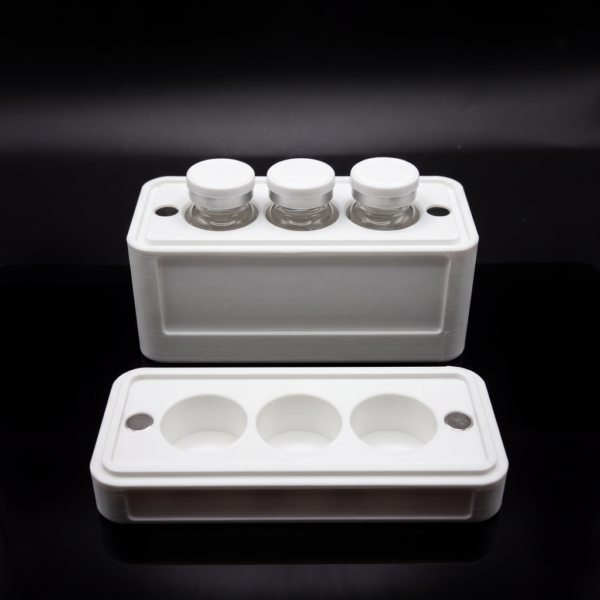
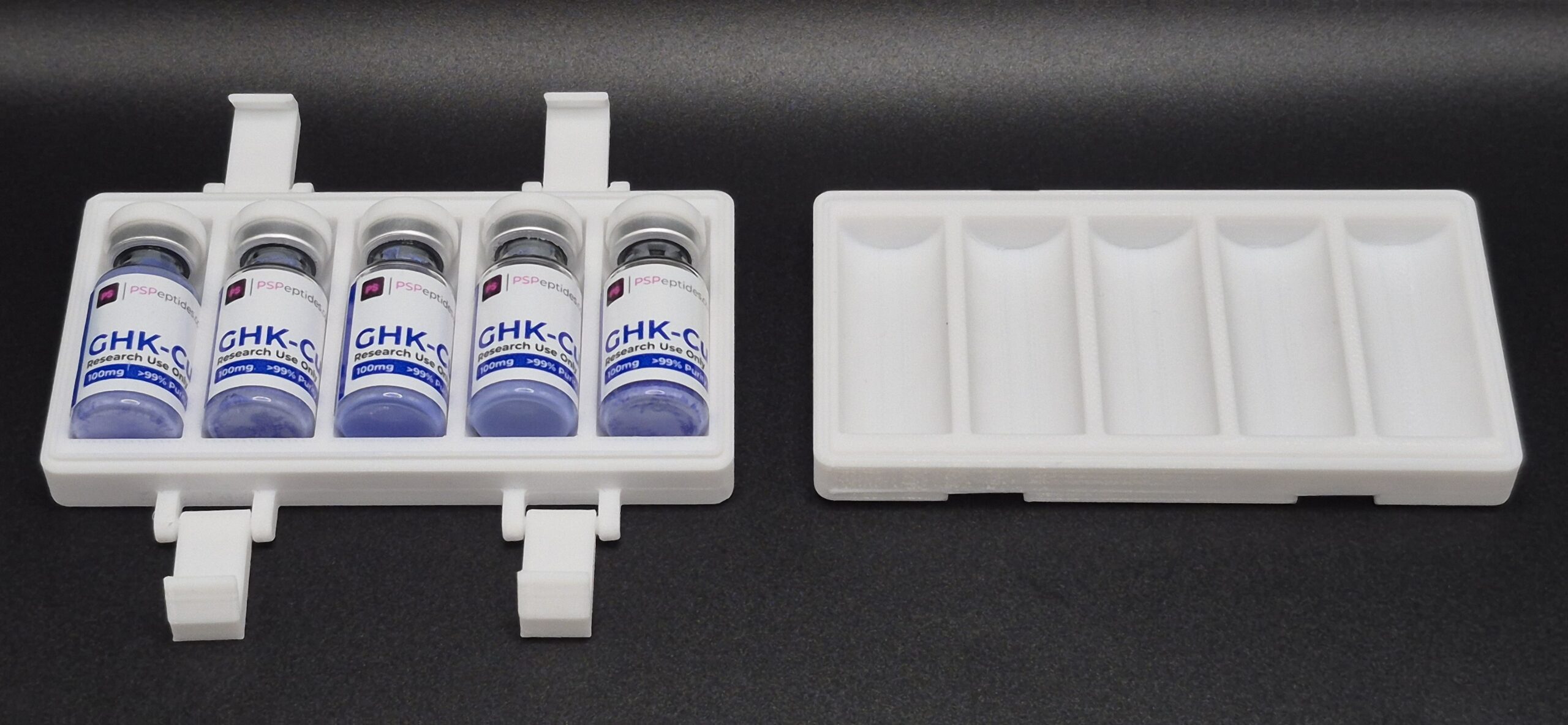
This peptide vial case is a purpose-built, two-piece holder for 3mL research vials. Five molded cradles in the base hold each vial on its side, and the lid carries five matching recesses that close over the top. Clip latches along both long edges lock the two halves together.
It is made for researchers who want a tidy, repeatable way to store and move a small working set of vials. For the fundamentals of temperature, light, and shelf life, read our peptide storage guide.
How the Peptide Vial Case Works
The design is simple on purpose. The base is a rigid tray with five side-by-side cradles, each shaped to the body of a 3mL vial. A vial drops into its cradle and stays there, with a solid wall between it and the next vial.
The lid mirrors the base. Five matching recesses sit over the upper half of each vial, so when the lid goes on, every vial is enclosed on all sides. Nothing slides lengthwise, and nothing rolls.
Clip latches on both long edges of the base fold up and snap over the lid. Because the lid lifts completely off, you get open access to all five vials at once, with no hinge to work around.
Vials lie on their side with the label facing up. That means you can open the peptide vial case and read every label at a glance, without lifting a single vial out to check what it is.
The low, flat profile is the other practical benefit. A row of five vials lying flat takes very little height, so the case slides onto a shelf, into a drawer, or into a bag pocket where a taller upright rack would not fit.

Peptide Vial Case Design Details That Matter
Small design choices decide whether a storage accessory gets used every day or ends up in a drawer. These are the details that set this peptide vial case apart from a generic box.
- One cradle per vial: Every vial has a fixed home, so positions can carry meaning in your notes.
- Matching lid recesses: The lid holds vials from above, not just from below, which keeps them seated when the case is carried.
- Clips on both sides: Latches on both long edges close the case evenly instead of relying on a single catch.
- Fully removable lid: The open base works as a staging tray during bench work.
- White finish: A clean white surface is easy to label and makes vial labels and colored caps easy to see.
- Slim footprint: Five vials in one flat row fit where a taller rack cannot.
Why Vial Organization Matters in Peptide Research
Research peptides are supplied in small glass vials that look nearly identical. Once a few of them are loose in a box, the only thing separating one compound from another is a label that can smudge, peel, or face the wrong way.
Mix-ups are the obvious risk, but they are not the only one. Loose vials roll, tip, and collide. A cracked vial or a damaged crimp seal means lost material and a gap in your data.
Handling time matters too. Every extra minute spent digging for the right vial is a minute that temperature-sensitive material sits outside controlled storage. A peptide vial case turns that search into a single motion: open, read, pick.
Organization also supports documentation. When each vial has a fixed position, your notes can reference that position. Slot one stays the same compound, lot, and reconstitution date until you decide otherwise.
None of this replaces correct storage conditions. A case is an organizer, not a refrigerator. It simply makes good habits easier to follow. To catch problems early, see our guide on how to tell if a peptide has degraded.
Published Research on Peptide Storage and Stability
The reasoning behind careful vial handling is well documented. In a widely cited review, Wang (1999, International Journal of Pharmaceutics) described how proteins face both physical and chemical instability, and why these materials usually have to be stored cold or freeze-dried to reach an acceptable shelf life. See Instability, stabilization, and formulation of liquid protein pharmaceuticals.
Manning and colleagues (2010, Pharmaceutical Research) updated that picture. Their review separates instability into chemical and physical classes, the latter including denaturation, aggregation, precipitation, and adsorption, and it discusses how the two interact. Read Stability of protein pharmaceuticals: an update.
Zapadka and colleagues (2017, Interface Focus) focused on peptides specifically. They reviewed the intrinsic and external factors that influence physical stability, including physical parameters such as temperature and agitation. See Factors affecting the physical stability of peptide therapeutics.
The takeaway for the bench is modest but real. Keep vials at the right temperature, limit unnecessary agitation and handling, and know exactly what is in each vial. A peptide vial case does not change peptide chemistry; it supports the handling discipline this literature points to.
Peptide Vial Case vs Alternatives
How does this 5-vial case compare with the PSPeptides 10-Slot Peptide Vial Storage Case, or with simply leaving vials in the box they shipped in? The table below covers the differences that matter day to day.
| Feature | 5-Vial Peptide Vial Case | 10-Slot Storage Case | Original Box or Zip Bag |
|---|
| Capacity | 5 vials | 10 vials | Varies |
| Vial Size | 3mL | 3mL | Any |
| Vial Position | On side, labels up | Upright, two rows of five | Loose |
| Individual Slots | Yes | Yes | No |
| Closure | Clip latches | Magnetic lid | Flap or zip |
| Vial-to-Vial Contact | None | None | Likely |
| Profile | Low and flat | Compact upright block | Irregular |
| Best For | One protocol or a small working set | Larger inventory kept together | Short-term only |
Choose the 5-vial peptide vial case when you run one protocol at a time or want a slim case for each compound. Choose the 10-slot case when you keep a larger inventory together. The two also pair well: stock in the 10-slot, working set in the 5-vial case.
Loading, Handling & Reconstitution Workflow
Loading the peptide vial case takes seconds. Release the clip latches, lift off the lid, and set each 3mL vial into a cradle with its label facing up. Replace the lid and snap the latches closed on both sides.
Before loading, wipe each vial dry. Condensation from cold storage can loosen labels, and a dry vial seats cleanly in its cradle.
During reconstitution, the open base doubles as a staging tray. Take out only the vial you are working with and leave the rest in their cradles. Volumes and technique are covered step by step in how to reconstitute peptides.
Work out concentrations before you open anything. Our peptide calculator guide walks through the research math, and what is bacteriostatic water explains the diluent most protocols call for.
After reconstitution, write the date and concentration on the vial label or on a slot map, then return the vial to the same cradle. Consistent positions are what keep a peptide vial case useful over weeks rather than days.
Carry the case level and avoid shaking it. With both sets of clips fastened, the vials stay seated, but gentle handling is still the right habit for any peptide in solution.
Five Practical Tips for Your Peptide Vial Case
- Assign positions: Decide what slots one through five mean, left to right, and keep that order every time you reload.
- Label the lid: A small label with the compound, lot number, and date tells you what is inside before you open the clips.
- One compound per case: When possible, dedicate a case to a single peptide or a single protocol so nothing has to be sorted later.
- Keep a slot map: A note card or a spreadsheet row listing slot, compound, lot, and reconstitution date takes one minute and prevents most mix-ups.
- Inspect on every open: Look for cloudiness, particles, cracked glass, or a loose seal each time, and pull any questionable vial from the set.
Common Vial Storage Mistakes to Avoid
Most storage problems are habits, not accidents. A dedicated peptide vial case removes the conditions that let these habits form.
- Loose vials in a bag: Glass on glass invites chips and cracked seals, especially when the bag is moved.
- Mixed lots in one box: Without fixed positions, vials from different batches blend together and COA tracking breaks down.
- Labels facing down: If you must pick up a vial to identify it, every vial gets handled more than it needs to be.
- Long searches with the door open: Hunting for one vial warms everything around it. A case comes out, opens, and goes back in.
- No record of dates: A reconstituted vial with no date is a guess. Positions plus a slot map solve this.
A peptide vial case will not fix a poor protocol, but it removes the friction that causes most of these errors.
Storage & Stability
The peptide vial case organizes vials; your storage environment protects them. Always follow the temperature guidance for the specific compound and the details on its Certificate of Analysis.
As a general rule in peptide research, lyophilized (freeze-dried) peptides are kept cold and dry for long-term storage, commonly frozen at around -20°C. Reconstituted peptides are kept refrigerated at 2–8°C and used within a much shorter window. Our peptide storage guide covers the details.
Light and repeated temperature swings are the other common concerns. Keeping vials together in a closed case, rather than loose on an open shelf, means the whole set returns to storage in one motion instead of five.
The case is not insulated and does not hold temperature on its own. For any trip outside cold storage, pair it with a cold pack and an insulated bag, and keep the time out of refrigeration short.
Keep the case itself clean and dry. Wipe it with a soft, lightly damp cloth, let it dry fully before reloading, and avoid harsh solvents and high heat.
Certificate of Analysis & Batch Tracking
Every PSPeptides peptide ships with a batch-specific Certificate of Analysis. The COA reports third-party HPLC purity and mass spectrometry identity for that exact lot. The case is a storage accessory, so it does not carry a COA of its own.
What the peptide vial case adds is traceability. Keep the vials from one lot together in one case and note the lot number on the lid or on your slot map. When you review results later, each vial traces back to its paperwork.
New to these documents? Our guide on how to read a peptide COA explains purity percentages, chromatograms, and mass spec data in plain language.
Build a Complete Storage Setup
A peptide vial case works best as part of a simple, repeatable system. It makes sense to add the supplies that go with it in the same order.
- The case: One peptide vial case per compound or per protocol keeps working sets separate.
- Research peptides: Vials are sold separately, each with a batch-specific COA.
- Bacteriostatic water: The standard diluent for reconstitution in most research protocols.
- Labels and a slot map: The low-cost step that makes everything else traceable.
Planning more than one compound? Our peptide stacking guide explains how researchers combine peptides, and a separate case for each compound keeps those protocols from overlapping on the shelf.
Ordering everything together also saves on shipping. Orders over $150 ship free by UPS 2nd Day Air, so adding a case to a peptide order is usually the most economical way to buy one.
Who Should Buy This Peptide Vial Case?
- Single-protocol researchers: Keep every vial for the current study in one place.
- Five-vial buyers: If you order peptides five vials at a time, the set stores exactly as it arrived, minus the loose packaging.
- Bench-to-fridge movers: Carry a full working set in one hand with every vial secured.
- Multi-compound labs: Use one peptide vial case per compound so peptides never share a container.
- Anyone done with boxes and bags: Replace improvised storage with a case made for the job.
If that sounds like your bench, scroll up and add the peptide vial case to your cart. It ships with the rest of your order, and in-stock orders placed before 2 PM EST leave the same day.
Why Researchers Choose PSPeptides
- US Manufactured: PSPeptides research peptides are made in the United States
- Third-Party Tested: Independent HPLC and mass spectrometry on peptide batches
- Fast Shipping: Free UPS 2nd Day Air over $150, same-day before 2 PM EST
- Flexible Payments: Credit cards, Afterpay, Klarna, Apple Pay, Google Pay
- 7-Day Support: Email, phone, or text
Comparing vendors before you buy? Our checklist on how to choose a research peptide supplier covers testing, documentation, and shipping standards.
Frequently Asked Questions
How many vials does the peptide vial case hold?
It holds five 3mL vials in a single row. Each vial has its own cradle in the base and its own recess in the lid, so no two vials touch.
What size vials fit the peptide vial case?
The cradles are sized for 3mL peptide vials. Smaller or larger vials may not seat securely, so we recommend this case for 3mL vials only.
Are vials included with the case?
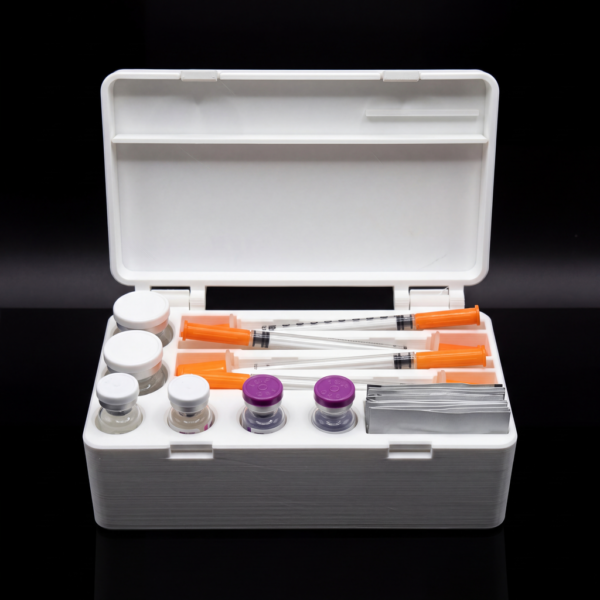
No. You receive one empty 5-vial case. The vials shown in the product photos illustrate fit and are sold separately.
Do the vials stand upright?
No. In this peptide vial case the vials rest on their side with labels facing up. If you prefer upright storage, the 10-Slot Peptide Vial Storage Case holds ten 3mL vials standing in individual slots.
Can I store reconstituted vials in it?
The cradles fit the same 3mL vials before and after reconstitution. Because vials rest on their side, check that each stopper and crimp seal is intact first. If your protocol calls for storing punctured vials upright, the 10-slot upright case is the better fit.
Will it fit in a refrigerator?
Yes. The slim, flat profile sits easily on a shelf or in a drawer. The case does not cool or insulate vials, so storage temperature still depends on where you keep it.
How do I clean the case?
Wipe it with a soft, lightly damp cloth and let it dry completely before loading vials. Avoid harsh solvents and high heat.
How fast does the peptide vial case ship?
In-stock orders placed before 2 PM EST ship the same day. Orders over $150 qualify for free UPS 2nd Day Air.
Related Resources
All PSPeptides products are sold exclusively for laboratory and research use. Not intended for human consumption.





 Made & Shipped