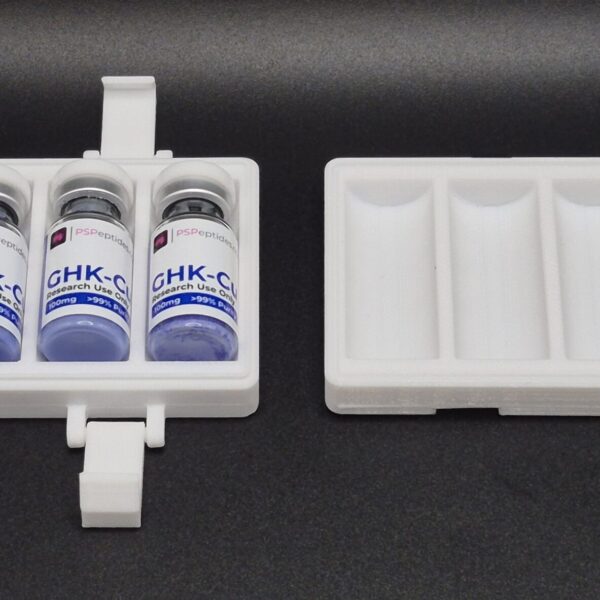
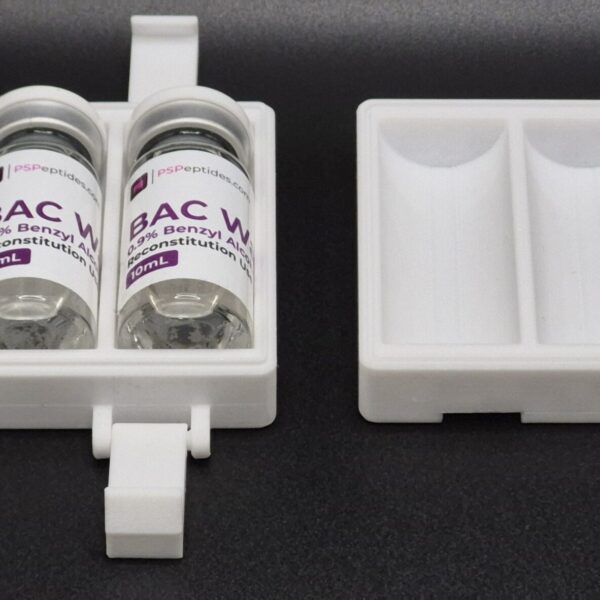
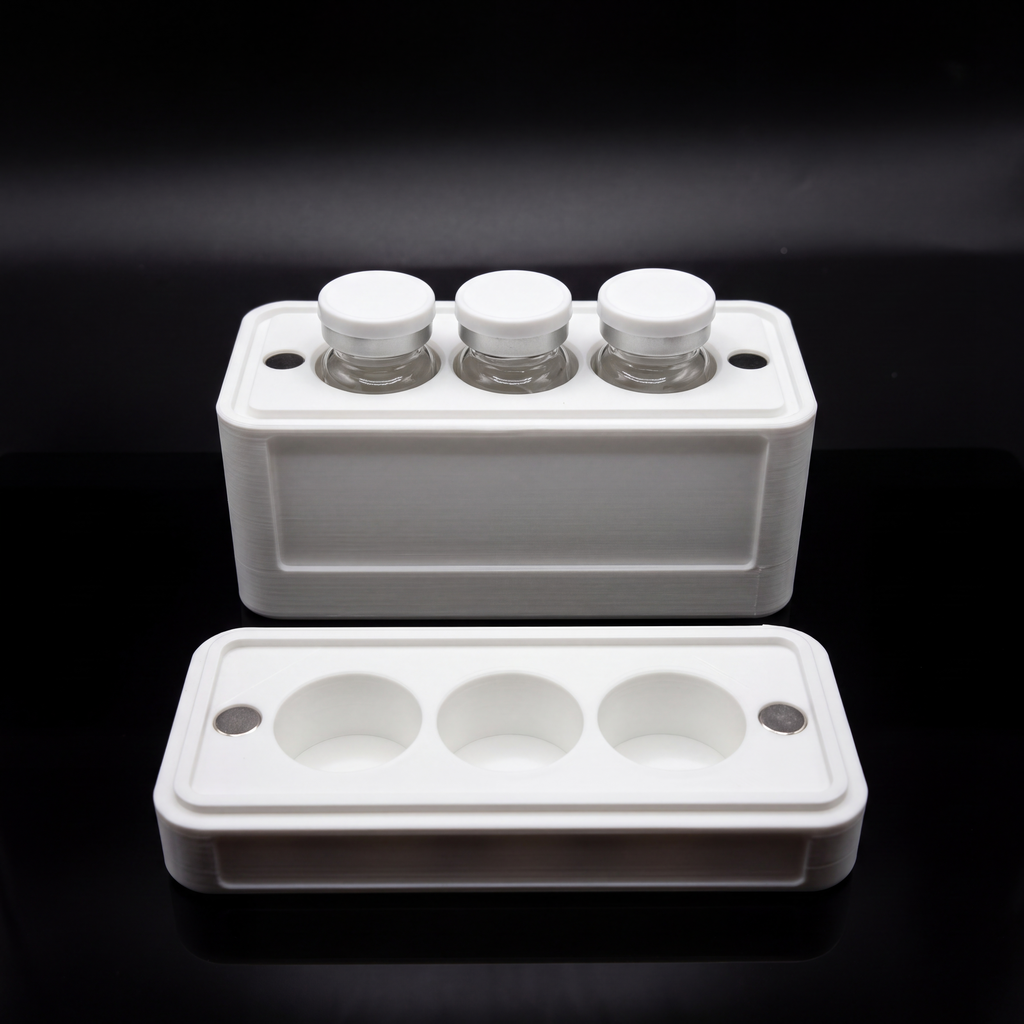
The BAC water vial case is a purpose-built holder for the 10mL vials used to reconstitute lyophilized research peptides. Three individual wells cradle each vial upright, and the magnetic lid settles over the vial tops with matching recesses. At a compact three-vial size, it fits a shelf, a drawer, or a travel bag and keeps the diluent you rely on in one predictable place.
How the BAC Water Vial Case Works
The design is simple on purpose. The base holds three round wells in a single row, each sized for a standard 10mL vial. Set a vial into a well and it stands upright, supported around its body instead of leaning on its neighbors.
The lid mirrors the base. Matching recesses settle over the vial caps, so every vial is held from above and below once the case is closed. Nothing slides, tips, or rolls when the case is picked up and moved.
Magnets at each end pull the lid into alignment and hold it shut. There are no latches to snap, no hinge to wear out, and no zipper to snag. Lift the lid to open the BAC water vial case, lower it again, and the magnets seat it for you.
That magnetic closure matters at the bench. Reconstitution usually means one hand on a syringe and the other on a vial. A case that opens with a light lift keeps the workflow moving and keeps your attention on technique rather than packaging.
The white finish is practical, too. A clean, bright surface makes vial labels easy to read and makes dust, drips, or residue easy to spot and wipe away before they become a problem.

Why Bacteriostatic Water Deserves Its Own Case
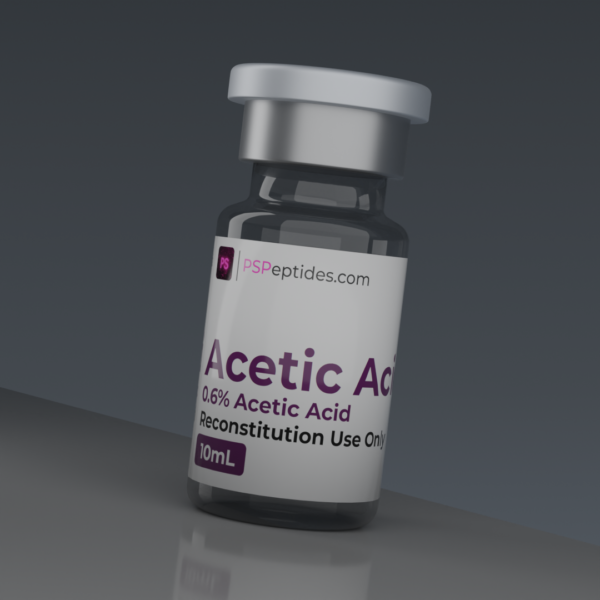
Bacteriostatic water is sterile water preserved with 0.9% benzyl alcohol. The preservative inhibits bacterial growth, which is why a single vial can be entered more than once over the course of a research protocol.
Because the same vial is used again and again over days or weeks, it gets handled far more than a single-use ampoule. Every trip in and out of storage is another chance for a drop, a knock, or a mix-up with a similar-looking vial.
A 10mL vial is also awkward to store loose. It is too tall for most small organizers, too narrow to stand reliably on a crowded shelf, and round enough to roll away. A dedicated BAC water vial case solves all three problems at once.
Researchers who run several compounds in parallel often keep more than one diluent vial on hand. Three slots let you separate vials by open date, by project, or by sealed versus in-use status, with no guesswork.
Published Research on Storage and Stability
The case is a storage accessory, not a research compound, but the reasons to store supplies carefully are well documented. In a widely cited review, Wang (1999) described how proteins are vulnerable to both chemical and physical instability, and why they usually need cold storage or freeze-drying to reach an acceptable shelf life.
A later update by Manning and colleagues (2010) summarized two decades of progress on stabilization in solution and in the dried state. Both reviews point in the same direction: handling and storage conditions shape how well sensitive materials hold up over time.
Diluent handling is part of that picture. A reconstituted peptide is only as dependable as the water it was mixed with, and a cracked, contaminated, or misidentified vial undermines everything downstream. Careful organization is a low-cost control that supports repeatable results.
For warning signs that a stored compound has changed, see our guide on how to tell if a peptide has degraded. For temperature and light recommendations at every stage, the peptide storage guide walks through each one.
BAC Water Vial Case vs Alternatives
| Feature | BAC Water Vial Case | Generic Storage Box | Loose in Bag or Drawer |
|---|
| Fit for 10mL vials | Wells sized for 10mL vials | Varies by box | No dedicated fit |
| Vial separation | Individual well per vial | Vials may touch | Vials touch and roll |
| Closure | Magnetic lid | Varies, often a friction lid | None |
| One-hand opening | Yes | Rarely | Not applicable |
| Vials stored upright | Yes | Not guaranteed | No |
| Portability | Compact and rigid | Often bulky | Unprotected |
| Easy to wipe clean | Smooth white surface | Varies | Not applicable |
| Organized inventory | Three defined positions | Limited | None |
A generic box will hold vials, but it will not hold them still. The BAC water vial case is built around one job, and that focus is exactly what protects your supplies.
What to Look for When You Buy a BAC Water Vial Case
Not every vial holder is worth buying. Before you place an order, compare any case against the checklist below.
- Correct sizing: Slots should be made for 10mL vials, not adapted from a smaller or larger format. A loose fit lets vials rattle, and a tight fit makes them hard to remove.
- Individual separation: Each vial needs its own well. Shared compartments allow glass-on-glass contact, which is the most common cause of chips and cracks.
- Secure closure: The lid should stay shut during normal handling. A magnetic closure does this without small moving parts that can fail.
- Upright storage: Vials stored upright are easier to read, easier to grab, and keep liquid away from the stopper between uses.
- Cleanable surface: Smooth, light-colored surfaces show residue and wipe down quickly.
- Compact footprint: A case should fit a shelf, a drawer, or a bag without wasting space.
The PSPeptides BAC water vial case checks every one of these boxes, which is why it is such an easy add-on to any diluent order.
Common Storage Mistakes This Case Helps Prevent
- Loose vials in a drawer: Vials roll, collide, and end up under other supplies. Fixed wells keep each one in a known position.
- Mixing opened and sealed stock: Without defined positions, it is easy to open a fresh vial while an older one is still in use. Three slots make the order obvious.
- Lost open dates: A vial with no date is a vial you cannot trust. A consistent home makes labeling part of the routine.
- Unprotected transport: Tossing glass vials into a bag invites breakage. A rigid shell with separated wells absorbs everyday bumps.
- Cluttered bench space: Scattered supplies slow every session. One small case keeps diluent in a single, predictable spot.
None of these mistakes is dramatic on its own, but each one costs time, money, or confidence in your materials. A BAC water vial case removes them with a single inexpensive purchase.
Who Should Buy This Case?
This case suits any researcher who keeps 10mL bacteriostatic water on hand. If you reconstitute peptides regularly, you already own the vials; the BAC water vial case simply gives them a proper home.
It is also a smart purchase for labs that share supplies. Defined slots make it obvious when a vial is missing, running low, or has been returned to the wrong place.
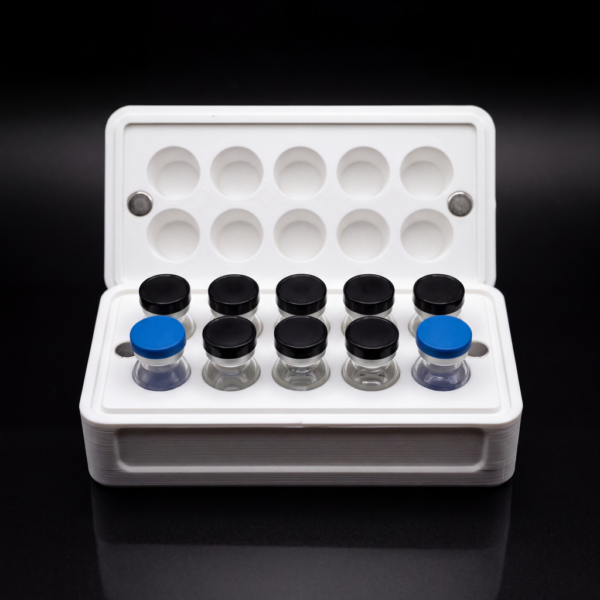
Need more capacity or a different format? PSPeptides also carries a five-slot 10mL peptide vial case, a three-slot case for 3mL vials, and a 10-slot peptide vial storage case for larger inventories.
Reconstitution & Handling
The case supports a clean, repeatable reconstitution routine. Open the BAC water vial case, lift out one vial, and wipe the stopper with an alcohol swab before drawing any diluent.
As a common example, adding 2mL of bacteriostatic water to a 10mg peptide vial yields a concentration of 5mg per mL. A single 10mL vial of diluent therefore covers several reconstitutions. Confirm your own volumes with our guide on how to use the peptide calculator.
Let the diluent run slowly down the inside wall of the peptide vial and swirl gently; never shake. Then return the water vial to its slot and close the lid. Our step-by-step reconstitution guide covers the full method.
Handle vials by the body rather than the cap, and avoid touching the stopper after it has been swabbed. Putting each vial straight back into its well keeps the bench clear and stops a round vial from rolling off the edge.
A Simple Three-Slot Labeling System
Three positions are enough to run a tidy rotation. Many researchers assign each slot a role and never have to think about it again.
- Left slot — sealed stock: An unopened vial waiting its turn.
- Center slot — in use: The vial currently being drawn from, labeled with the date it was first entered.
- Right slot — next in line: A backup vial, so a session never stalls because the diluent ran out.
Write the open date on each vial with a fine marker or a small label. When the center vial is finished or expires, shift the others over and reorder. The BAC water vial case turns that habit into a system you can see at a glance.
Storage & Stability
Always follow the storage directions printed on your bacteriostatic water label. Unopened vials are generally kept at controlled room temperature, around 20 to 25°C (68 to 77°F), away from heat sources and direct light.
Once a multi-use vial has been entered, it is commonly discarded after 28 days. Keeping opened vials in a BAC water vial case with dated labels makes that window easy to track and hard to forget.
Do not freeze bacteriostatic water, and discard any vial that looks cloudy, discolored, or cracked. Inspect the stopper as well; a damaged stopper is a reason to replace the vial, not to keep using it.
Remember that peptides have different needs than diluent. Lyophilized and reconstituted compounds usually call for colder storage, so check the requirements for each material rather than storing everything in the same place by default.
Care and Cleaning
The case needs very little maintenance. Wipe the wells and the inside of the lid with a soft, lint-free cloth between uses, and let every surface dry fully before reloading vials.
Keep the BAC water vial case closed when it is not in use. A closed lid keeps dust out of the wells and shields the vials from light, bumps, and accidental spills on the bench.
Quality & Certificate of Analysis
A storage case does not carry a Certificate of Analysis; COAs apply to the compounds you keep beside it. PSPeptides research peptides include a batch-specific COA showing HPLC purity and mass spectrometry identity.
Learn how to interpret those documents in our guide to reading a peptide COA. Good documentation and good storage work together: one confirms what you received, and the other helps keep it that way.
The BAC water vial case rounds out that system by giving your diluent the same level of care you already give your compounds.
Why Researchers Choose PSPeptides
- US Manufactured: PSPeptides research peptides are made in the USA.
- Third-Party Tested: Independent HPLC and mass spectrometry on research peptides, with batch-specific COAs.
- Fast Shipping: Free UPS 2nd Day Air over $150, same-day shipping before 2 PM EST.
- Flexible Payments: Credit cards, Afterpay, Klarna, Apple Pay, Google Pay.
- 7-Day Support: Email, phone, or text.
When you buy a BAC water vial case from PSPeptides, it ships with the same speed and support as every other item in the catalog, and it can travel in the same box as your peptides and diluent.
Building a Complete Reconstitution Kit
The BAC water vial case is one part of a tidy bench setup. Pair it with bacteriostatic water, alcohol swabs, and appropriately sized syringes so everything needed for reconstitution lives in one place.
Add a peptide vial case for your lyophilized vials and you have separate, clearly labeled homes for diluent and compounds. That separation reduces mix-ups and shortens the setup time for every session.
Assembling supplies for the first time? Our guide to choosing a research peptide supplier explains what to look for, and the complete guide to peptides covers the fundamentals.
Frequently Asked Questions
What size vials fit the BAC water vial case?
The case is sized for 10mL vials, the common format for bacteriostatic water used in peptide research. It holds three vials, each in its own well. Smaller 3mL vials will sit loosely, so choose a 3mL peptide vial case for those.
How does the magnetic lid work?
Magnets at each end of the case hold the lid to the base. Lift the lid to open it, then set it back down to close; the magnets guide it into place. There are no latches to operate.
Does the BAC water vial case include bacteriostatic water?
No. This listing is for the case only, and vials are sold separately. Add bacteriostatic water to your cart to fill all three slots in one order.
Can I store peptide vials in this case?
Yes, the wells accept other 10mL research vials as well. Keep in mind that peptides often need colder storage than diluent, so follow the storage requirements for each compound.
Is the BAC water vial case good for travel?
Yes. Its rigid body and separated wells keep vials from knocking together in a bag, and the magnetic lid holds the case shut during normal handling. For rough transit, place the case inside a padded pouch for extra security.
How many vials do I need to fill the case?
Three 10mL vials fill every slot. Many researchers keep one vial in use and two in reserve, which is enough diluent for a long run of reconstitutions without reordering.
How do I clean the case?
Wipe the wells and lid with a soft, lint-free cloth and allow them to dry completely. Avoid reloading vials while any surface is still damp.
How fast does the BAC water vial case ship?
Orders placed before 2 PM EST ship the same day. Orders over $150 qualify for free UPS 2nd Day Air, so adding a case to a larger order is often the most economical way to buy.
Order Your BAC Water Vial Case Today
Loose vials get dropped, lost, and mixed up. A BAC water vial case costs less than replacing a few broken vials, and it keeps your diluent protected from the first day it arrives.
Add the BAC water vial case to your cart now, pair it with bacteriostatic water, and check out with a credit card, Afterpay, Klarna, Apple Pay, or Google Pay. Shop now and have your supplies organized this week.
Related Resources
All PSPeptides products are sold exclusively for laboratory and research use. Not intended for human consumption.





 Made & Shipped